

 français
 Deutsch
 русский
 italiano
 español
 日本語
日本語 Türkçe
 Tiếng việt
 Indonesia
You can contact us any way that is convenient for you. We are available 24/7 via email or telephone.
Contact Us
Why Forging Automation Requires Higher Die System Accuracy
When forging plants upgrade from manual production to automated lines, many assume the main challenge lies in robots — payload, speed, or programming.
In reality, most automation problems originate from the die system, not the robot.
Robots Rely on Coordinates, Not Human Judgment
Unlike manual operators, robots do not visually adjust part positions.
They follow fixed coordinate systems and assume that:
If the die system cannot guarantee repeatable positioning, automation becomes unreliable.
Guiding Accuracy Becomes Critical in Automation
In manual forging lines, small misalignments can be tolerated and compensated by operators.
In automated lines, even a 1–2 mm deviation may cause:
This is why guiding accuracy of the die set becomes a key requirement for automation.
Die Systems Define the Automation Reference
In a forging automation line, the die system is not only a mechanical structure —
it becomes the reference platform for the entire process, including:
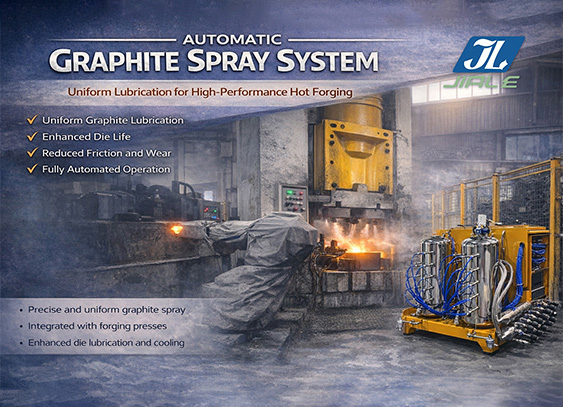
For systems such as automatic graphite lubrication,spray accuracy depends directly on stable and repeatable die positioning.
If the die system shifts, spray alignment drifts, leading to uneven lubrication, material buildup, or marking errors.
Mechanical Accuracy Comes First
Some plants attempt to compensate mechanical instability with vision systems or software correction.
While helpful, software cannot replace structural precision.
In forging automation, mechanical accuracy must be established first — robots, manipulators,lubrication spray systems can only perform well on a stable foundation.
Automation Is a System Upgrade
Successful forging automation is not achieved by adding robots alone.
It requires upgrading the entire process platform.




 IPv6 network supported